

 In Stock

 Low Stock
- NEWS RELEASE: Gold Bank London reveals latest World Cup trophy insights
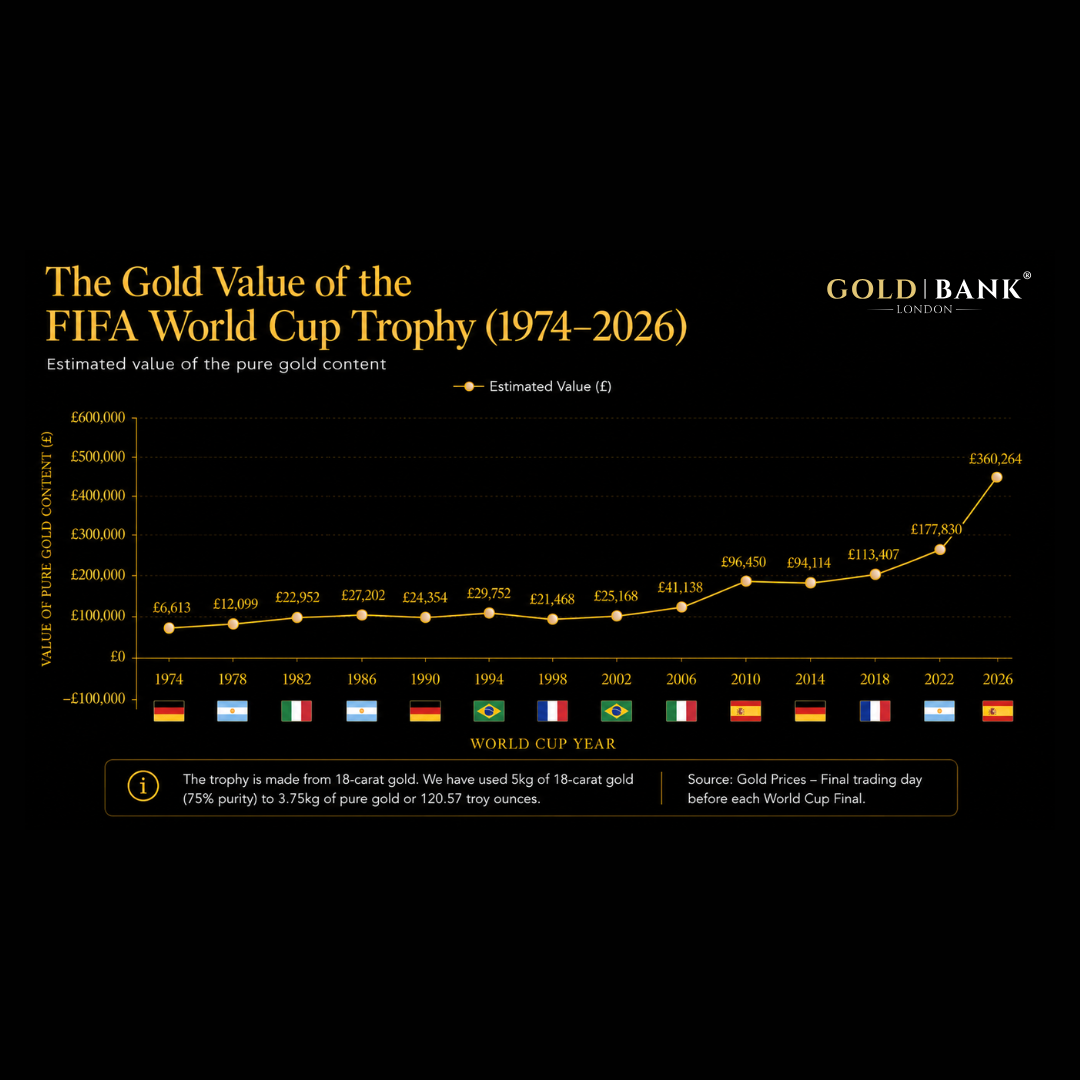
According to Gold Bank, the FIFA World Cup trophy’s 18-carat gold content declined in value by £20,134, or 5.3%, during the 2026 tournament as it played out over 39 days – from 11 June to 19 July – the longest and biggest World Cup in history, with 48 teams competing.
At the start of the World Cup just over five weeks ago, the trophy’s pure gold content was worth an estimated £380,398. By the time Spain secured the title on Sunday, the figure had fallen to £360,264.
Despite the current period of geopolitical uncertainty, in which gold prices are usually expected to rise, escalating tensions in the Middle East have caused gold prices to fall. Due to the World Cup trophy’s value being directly linked to the price of gold, its estimated pure gold value has dropped.
Over the course of the tournament, and a total of 104 World Cup matches, the US and Iran exchanged missile and drone strikes, while Iran threatened to close the Strait of Hormuz – a vital shipping route through which around one-fifth of the world’s seaborne oil passes. The prospect of disrupted oil supplies pushed oil prices higher and rather than buying gold, investors focused on the risk that higher energy prices posed relating to elevated inflation and delayed interest rate cuts. That strengthened the US dollar and negatively impacted the price of gold.
Faisel Ali, Gold Bank London’s Founder and Managing Director, said, “Firstly, congratulations to Spain on winning what has been a fantastic World Cup. The trophy itself is priceless, but as someone who has worked in the gold industry for more than 30 years, I find it fascinating to see how the value of the gold inside it has changed over the decades.
“The same trophy has been lifted by generations of football legends, but the gold it’s made of has also lived through oil crises, financial crashes, pandemics and geopolitical conflicts. Looking at how its value has changed is another way of looking back at world history.
“For investors, it’s another reminder that gold has reflected changing economic conditions while continuing to play an important role as a long-term store of value.”
Find out more about what the World Cup trophy is worth and how its value has changed since it was first awarded in 1974.
For further information on Gold Bank London, visit goldbank.co.uk or contact: