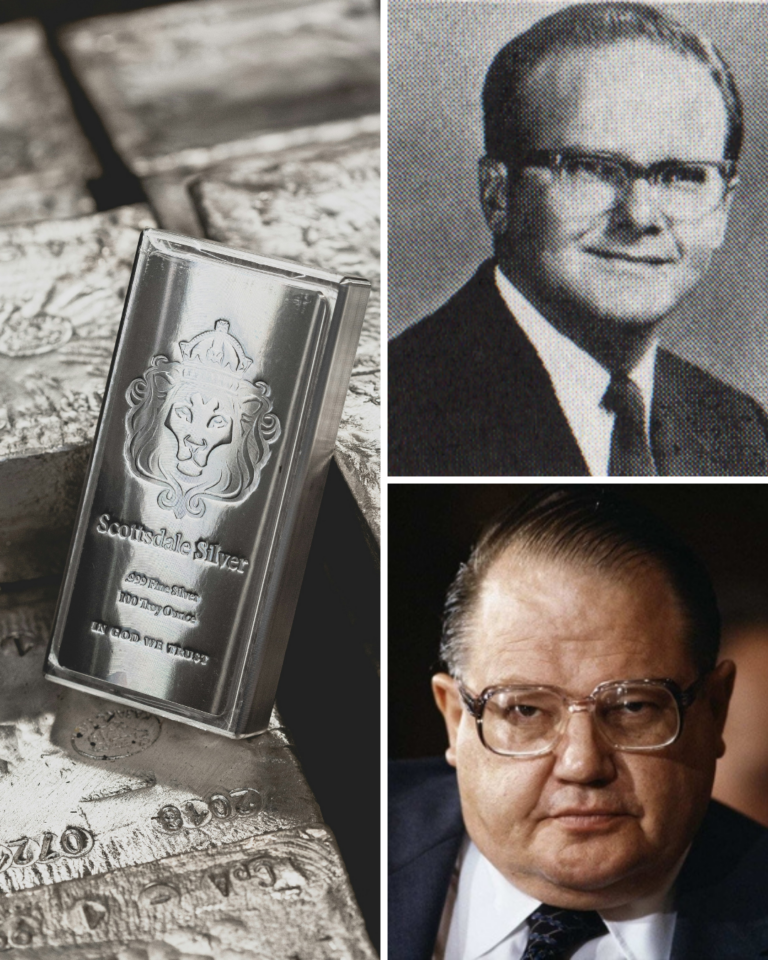

What do you think would happen if someone tried to buy all the silver?
Because in the late 1970s, two billionaire brothers attempted to do exactly that. They accumulated so much silver that they were able to influence the global market.
So what’s the story?
At the time, the world economy was under pressure. Inflation was soaring, confidence in paper currencies was weakening and the United States had recently abandoned the gold standard. Many investors were looking for hard assets they believed could hold value if the financial system deteriorated further.
Texas oil heirs Nelson Bunker Hunt and William Herbert Hunt believed silver was the answer.
So they started buying. And buying. And buying.
Through a combination of physical silver purchases and huge futures positions, the Hunt brothers helped drive silver prices from around $6 an ounce in early 1979 to nearly $50 by January 1980.
What followed became known as “Silver Thursday”, one of the most dramatic commodity crashes in financial history. Prices plunged, billions were wiped out and the Hunt brothers’ attempt to dominate the silver market unravelled spectacularly.
Who were the Hunt brothers?
Nelson Bunker Hunt and William Herbert Hunt were not ordinary investors. They were heirs to one of the largest oil fortunes in the United States, built by their father, H.L. Hunt, who became one of the richest men in America through the Texas oil boom.
By the 1970s, the Hunt family name was already linked with enormous wealth and influence. The brothers themselves were known for taking big risks and thinking on a huge scale.
Their interest in silver did not appear out of nowhere.
The economic mood at the time was deeply unsettled. Inflation in the United States had surged into double digits, oil prices had jumped and confidence in governments’ ability to steady the economy was weakening. The old system where the dollar had been tied to gold had disappeared and many investors, including the Hunt brothers, were starting to question the long-term strength of paper currencies.
They believed silver and gold would hold their value if inflation kept rising or confidence in currencies weakened further. Silver in particular caught their attention because the market was much smaller than gold, meaning large purchases could move prices far more dramatically.
At least at first, the Hunts did not necessarily see themselves as manipulators. In their minds, they were protecting their wealth from a financial system they no longer fully trusted.
How the Hunt brothers pushed silver prices higher
The Hunt brothers bought enormous quantities of physical silver, reportedly taking delivery of real bullion and storing it in vaults around the world.
They also went a step further, by using futures contracts – agreements to buy silver at a later date for a fixed price. Futures allowed them to control far larger amounts of silver than they could have ordinarily purchased outright with cash.
As their buying accelerated, the market began to tighten. More demand was chasing a relatively limited supply of silver, and prices started climbing rapidly, which attracted even more attention from investors and speculators, adding further momentum to the rally.
This is where the phrase “cornering the market” comes from. It means trying to gain enough control over the available supply of an asset that you can heavily influence its price.
At one stage, the Hunt brothers and their associates were believed to control a huge share of the world’s deliverable silver supply.
Silver prices responded dramatically. In early 1979, silver traded at around $6 an ounce. By January 1980, it had climbed close to $50.
The higher prices rose, the more attention silver received – and the more unstable the situation became.
Tiffany & Co publicly condemned the silver frenzy
The situation for other prospective purchasers of silver was so dire that on March 26 1980, Walter Hoving, chairman of the board of Tiffany Company, the Fifth Avenue jeweller took out an ad in The New York Times, publicly criticising the Hunt brothers.
It stated: Anyone who hoards several billion dollars worth of silver, driving up prices of baby spoons, tea sets and photographic film, is guilty of “unconscionable” conduct.
When the market finally cracked
For a while, the rise in silver prices looked unstoppable but underneath the surface, the market had become heavily dependent on borrowed money and ever-rising prices. The higher silver climbed, the more vulnerable the whole system became to any sudden change.
That change arrived in early 1980.
Commodity exchanges, concerned about extreme speculation in the silver market, introduced stricter trading rules. Margin requirements – essentially the cash traders had to put up against their positions – were increased sharply. Some exchanges also restricted certain types of silver buying.
This immediately put pressure on investors who had borrowed heavily to maintain large positions.
The Hunt brothers suddenly faced enormous margin calls, demands for additional cash to support their trades. As prices started falling, lenders became nervous and more investors rushed to sell.
The momentum which had driven silver higher now worked violently in reverse.
On 27 March 1980, a day which became known as “Silver Thursday”, panic spread through the market. Silver prices collapsed, financial institutions feared major defaults.
The Hunt brothers’ empire began to unravel.
The lasting impact of Silver Thursday
The collapse of the silver market did not just hurt the Hunt brothers. It sent shockwaves through the wider financial system.
On Silver Thursday itself, silver plunged from around $21.62 to $10.80 an ounce in a single day, roughly a 50% collapse. The Hunt brothers were unable to meet margin calls reportedly ranging between $100 million and $135 million.
At the height of the panic, fears spread far beyond the silver market. Regulators and banks worried that if the Hunts defaulted completely, major Wall Street brokers and lenders could also be dragged into crisis. A consortium of US banks eventually stepped in with a rescue package worth roughly $1.1 billion to stabilise the situation.
The brothers’ estimated net worth reportedly fell from around $5 billion in 1980 to less than $1 billion by the late 1980s. In 1988, they were found liable for attempting to corner the silver market and ordered to pay more than $130 million in damages.
The fallout changed how commodity markets were viewed. Exchanges tightened rules around leverage and concentrated positions, and Silver Thursday became one of the clearest examples of how speculation and borrowed money can destabilise even major financial markets.
The Hunt brothers spent millions just moving and storing silver
The Hunt brothers’ silver hoard became so enormous that transporting and storing it turned into a multi-million-dollar operation in itself.
At one point, they reportedly chartered three Boeing 707 aircraft to move silver to Switzerland, costing close to $200,000 at the time, roughly $9 million in today’s money when adjusted for inflation.
And the storage costs were staggering too. Keeping around 55 million ounces of silver in vaults across the US and Europe reportedly cost the brothers about $3 million per year in storage fees alone, back when silver was still trading below $5 an ounce.
Silver vs gold: why silver proved more volatile
The Hunt brothers saga also highlighted an important difference between silver and gold as markets.
Although both are precious metals, they do not always behave in the same way.
Silver has always historically been more volatile than gold. One reason is size. The global gold market is far larger and deeper, making it harder for a small number of investors to heavily influence prices. Silver, by comparison, is a smaller market, which means large buying or selling activity can have a more dramatic effect.
Silver also sits in an unusual position because it is both a precious metal and an industrial one. Demand can be influenced not only by investor sentiment, but also by manufacturing, electronics and wider economic conditions.
While gold prices certainly move, gold has generally been viewed more as a long-term store of value and reserve asset. Central banks hold gold reserves, governments monitor it closely and the market itself tends to be broader and more liquid.
That does not make gold immune from volatility. But the Hunt brothers episode showed how quickly a smaller, more speculative market could spiral when momentum and leverage take over.
As the saying often goes: gold moves, silver swings.
What investors still learn from the Hunt brothers today
More than forty years later, people still talk about the Hunt brothers because the story feels surprisingly familiar.
The saga showed how dangerous borrowed money can become in fast-moving markets. Using leverage can magnify gains on the way up, but it can make losses spiral incredibly quickly on the way down. When markets turn, investors can be forced to sell simply to cover their positions, which often pushes prices down even further.
We have seen versions of this dynamic repeatedly since.
During the 2021 meme stock frenzy, shares in GameStop surged more than 1,600% within weeks as retail traders piled into the stock, despite little changing in the underlying business itself. At one point, the stock briefly touched $483 per share before violently reversing.
Crypto markets have also gone through similar boom-and-bust cycles, where rapid inflows of money and speculation pushed prices sharply higher before sentiment suddenly reversed.
The assets themselves may be different, but the underlying psychology often looks remarkably familiar.
And perhaps that is the biggest lesson from the Hunt brothers story: there is a difference between believing in an asset long term and believing prices can only move one way.
This is the third article in our series exploring the major decisions that have shaped commodities in the modern financial markets. If you would like to understand how silver or gold could fit into your own long-term plans, you can explore more of our latest guides and tools.