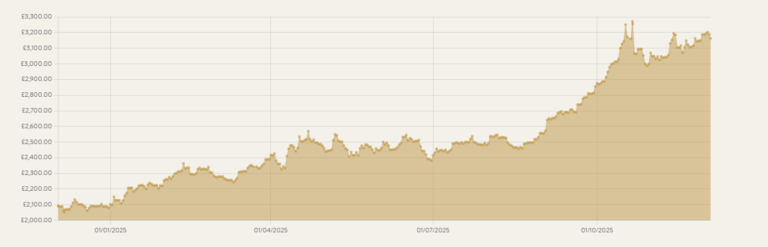

If you have investment gold, 2025 has been a year worth paying attention to.
Prices have smashed through one record after another. Gold has traded above $4,000 an ounce for the first time ever, briefly pushing past $4,300 in October before easing back.
So what’s behind gold’s surge in 2025, how does this year fit into the bigger story – and – what should you think about if you’re planning to buy or sell as we roll into 2026?
A year in gold: where it started vs where it is now
Start of 2025
On 2 January 2025, spot gold closed at about $2,624 per ounce. By the end of January, it was already closer to $2,800, up around 6-7% for the month.
End of 2025 (so far)
As of 2 December 2025, spot gold is trading around $4,220 per ounce, having opened the day slightly above $4,230 and moving within a narrow range.
That means gold is up roughly 60% year to date, which lines up with central-bank commentary suggesting a rise of around 59% in 2025 – its biggest year since 1979.
The 2025 high
Gold has set multiple all-time highs this year. Key milestones include:
- It first broke through $4,000 per ounce in early October
- It then extended the rally beyond $4,200 later that month
- According to Russia’s central bank, it hit a record of about $4,381 per ounce on 20 October
In real terms, the 2025 peak has been in the $4,300–4,400 range.
The global backdrop: why gold has surged
Three big forces have pushed gold higher in 2025, they include:
- Central bank buying and reserve diversification
Emerging market central banks have been stocking up on gold, partly to reduce their reliance on the US dollar and partly as a buffer against geopolitical risk. Russia’s central bank even linked the surge in global demand to concerns over G7 moves to repurpose Moscow’s frozen assets, according to Reuters. It’s a reminder that when governments get nervous, they reach for gold just like everyone else. - Geopolitical tension and economic uncertainty
Conflicts, trade frictions and choppy growth have pushed more investors towards safe assets. When the world feels shaky, gold usually moves the opposite way. - Interest rate expectations
Markets are now looking ahead to rate cuts rather than hikes, which reduces the “penalty” for holding gold instead of interest-earning assets. The World Gold Council points out that the jump from $3,500 to $4,000 took only 36 days, helped by falling rate expectations, a softer dollar and wobbly equity and bond markets.
2025 has served up the perfect mix of reasons for investors and central banks to lean into gold.
Post October: The gold price plateau
After a year of record-breaking highs, it’s no surprise the market has taken a breather. Even with the big long-term forces still pushing in gold’s favour, prices have steadied in the low $4,200s since the October spike. So what’s behind the pause?
- Profit-taking after a huge run
After a 50-60% rise in less than a year, some investors have taken the chance to lock in profits. That wave of selling takes a bit of heat out of the market and naturally slows the pace. - Markets waiting on the Federal Reserve and data
Recent trading sessions have seen gold ‘hold steady’ as investors wait for key US data and confirmation of rate-cut timings.
When rate expectations are in flux, traders tend to pause rather than chase new highs. - Slight improvement in risk appetite
Equity markets have clawed back some ground and recession worries have eased in a few regions. When stocks look a bit brighter, the rush into safe havens naturally slows. It doesn’t change the long-term case for gold, but it does take some of the urgency out of the market. - Technical consolidation
Markets never travel in a straight line. After blasting through big psychological milestones at $3,000, $3,500 and then $4,000, a bit of sideways movement is normal. It’s the market catching its breath while investors work out what comes next.
So the plateau is less a sign that the story is over and more that the market is catching its breath.
Gold price predictions: what do the experts say?
Forecasts are never a sure thing, but it helps to know what the big institutions and analysts are expecting before you make any decisions of your own.
Goldman Sachs client survey
Goldman Sachs recently asked more than 900 institutional investors where they think gold is heading between now and 2026. This was their mood:
- Nearly 70% expect prices to keep rising
- 36% think gold will pass $5,000 an ounce by the end of 2026
- Around a third see it landing somewhere between $4,500 and $5,000
- Only a small minority expect a fall back towards the $3,500 to $4,000 range
Investors pointed to two big drivers behind their optimism: central bank buying and fiscal worries such as government debt and budget pressure. In short, the same forces that lifted gold in 2025 have not gone anywhere.
World Bank outlook
The World Bank’s latest commodity outlook notes that after an estimated 41% jump in 2025, precious metals look set to hit fresh all-time highs in 2026. Safe-haven demand and ongoing central bank purchases are expected to do most of the heavy lifting.
Industry commentary
The World Gold Council notes that 2025 has been unusually active, with more than 40 record highs set this year alone. Their analysis points out that the jump from $3,500 to $4,000 happened in just over a month, driven by a mix of shifting rate expectations, global uncertainty and a wobblier dollar. In other words, the fundamentals that pushed gold up in the first place have been working overtime.
If those same drivers continue into next year, most analysts expect gold to stay on the front foot rather than give back its gains. The pace may slow, the spikes may be smaller and the journey will be bumpier, but the underlying forces pushing gold higher in 2025 have not disappeared. Central banks are still buying, global risks are still simmering and investors are still looking for safety when markets get jumpy. All of that creates a backdrop where gold may not need to ‘break records every week’ to stay strong in 2026.
What does this mean if you want to buy gold in 2026?
If you are thinking about buying, you are looking at a market that is:
- Much more expensive than it was at the start of 2025
- Still below its recent October peak
- Widely expected, by big institutions, to have further room to rise over the next few years
You’re buying into strength, not hunting for a bargain
At around $4,200 an ounce, gold is sitting nearer the top of its recent range than the bottom. A short-term dip is always possible, so it’s worth going in with eyes open.
Think in years, not weeks
If you buy now, see it as a long-term move. Gold’s story is driven by slow-burning forces like central bank demand, government debt and currency concerns, not quick bursts of speculation.
Be clear about what you’re actually buying
If you want an investment, bars and coins follow the spot price far more closely. Jewellery comes with workmanship costs you won’t get back when you sell, so simple high-purity pieces make more sense for value-focused buyers.
Do the basics well
Check the essentials every time:
- Purity
- Hallmarking
- Buy-back policy
- Premiums over spot
And if you’re buying in the UK, see how closely a dealer tracks the live UK gold rate in pounds per ounce or per gram. It’s one of the quickest ways to tell whether the price in front of you is fair.
What does this mean if you want to sell gold?
If you already own gold, 2025 has handed you a very strong backdrop.
You’re selling into a historically high market
Compared with the start of the year, prices are up in the region of 60 percent. Even against January’s $2,800 level, the current $4,200 range is a huge jump. If you’ve got pieces sitting in a drawer, you’re in far better territory than you were twelve months ago.
Forget trying to hit the perfect top
No one times the absolute peak. If you sell unused jewellery or coins now, you’re still locking in a gain that would have looked ambitious at the start of the year. Perfection isn’t required to make a good decision.
But the long-term story hasn’t disappeared
Central banks and big institutions are still buying. Several forecasters see potential for $4,500 to $5,000 over the next couple of years, even after this year’s surge. If you don’t need the cash right away, holding remains a reasonable choice.
It comes down to your situation
Sensible reasons to sell now might include:
- Clearing expensive debt
- Covering important costs
- Trimming a portfolio that’s become too gold-heavy
Sensible reasons to hold might be:
- You see gold as long-term protection
- You’re comfortable with price swings
- You expect more economic or geopolitical bumps ahead
Whatever you choose, remember this isn’t a quiet, steady market. These are elevated prices in a world that’s still anything but calm, so the right move is the one that works for your finances, not the headlines.
What this means for you and your 2026
If you’re thinking about selling your gold, now is the moment to get clear, transparent valuations and line them up against the live UK rate instead of guessing what your jewellery, coins or bars might be worth. And if you’re thinking about buying, keep it realistic. You’re paying a premium for the protection gold gives you, so it’s worth treating the purchase as a long-term move rather than a quick win.
This article is for general information only and is not financial advice. Gold prices can go up or down, so always do your own research or speak to a regulated adviser before making investment decisions.
Buying, selling or still weighing up your options for 2026? Gold Bank has your back. Get straight, transparent valuations and real-time prices so you can move with confidence in whichever direction you choose. Visit our website for more information